 AstraSentra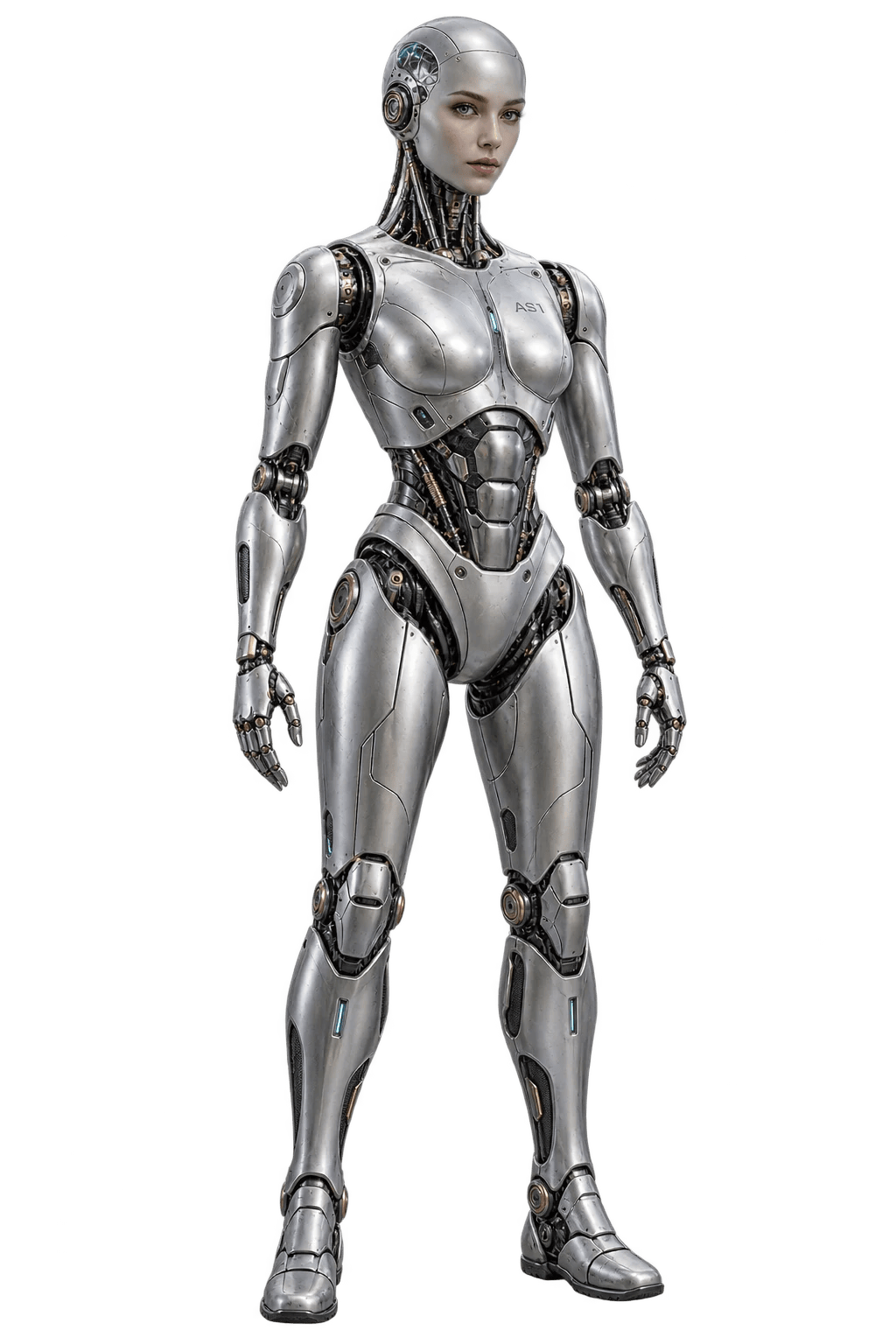
AS1.
Series One.
Human form.
Mission purpose.
AstraSentra’s private-label humanoid concept.
Capability begins
with a clear purpose.
AS1 is AstraSentra’s proposed own-label humanoid development programme. The current work establishes a digital design language and an initial requirements brief for technology, engineering and manufacturing partners.
Human architecture.
A lifelike synthetic face, sculpted platinum cranium and fine neck mechanisms. A slender outer shell, articulated hands and visible joint architecture establish a more human design language.
Mission adaptability.
A proposed modular approach for inspection, logistics, research and supervised response support. Each use case requires its own validation.
International collaboration.
A programme open to relevant robotics, actuation, sensing, compute and manufacturing partners across borders. The final engineering architecture remains to be selected.
Move your pointer across the figure to explore every side.
Tap a view to inspect. Select Auto views to cycle.
AI concept visualisation / 8 viewing anglesAS1.
A more human form.
A lifelike synthetic face. Brushed platinum surfaces. Precision mechanics within a slender, human-scale form. Meet AstraSentra’s private-label humanoid design study.
Human form. Useful purpose.
Designed around human spaces and human-supervised tasks: assistive logistics, inspection, research and response support.
Intelligence with human control.
The proposed architecture combines local AI, teleoperation, permissioned tasks and safe-state behaviour. These are development requirements, not tested capabilities.
AstraSentra’s development pathway.
From digital design and partner assessment to engineering, prototypes and supervised validation. Progress is gated by evidence.
Design concept. Specifications are proposed targets; no production model, certification or deployment is claimed.
A disciplined
starting point.
These are programme targets for feasibility assessment. They are not measured performance, certified specifications or a product offer.
| Form | Electric bipedal humanoid; approximately 1.88 m concept height |
|---|---|
| Target mass | 65–80 kg, subject to detailed design |
| Articulation | 30+ actuated body degrees of freedom; dexterous five-finger hand concept |
| Target carrying task | Up to 10 kg combined, close to the torso; payload and stability to be validated |
| Target walking speed | Up to 1.5 m/s on controlled, level surfaces |
| Power concept | Serviceable battery system; two-hour mixed-duty endurance target, workload dependent |
| Perception concept | Stereo/RGB and depth sensing, IMU, joint feedback; optional thermal sensing for response work |
| AI architecture | Modular edge inference with task policies, teleoperation and human-supervised autonomy |
| Connectivity concept | Local wired/wireless operation; optional private-network integration subject to programme needs |
| Security requirements | Role-based access, authenticated commands, signed updates and event logging |
| Initial operating envelope | Supervised indoor trials; outdoor and environmental protection targets require engineering validation |
| Human control | Accessible emergency stop, remote stop, permissioned task execution and safe-state behaviour |
Build the evidence.
Then move forward.
Current
Design language
Digital form study, brand identity and initial programme requirements.
Proposed
Engineering feasibility
Actuation, mass, power, thermal and stability assessment; technology partner selection.
Proposed
Prototype & simulation
Simulation, bench systems and controlled prototype evaluation.
Proposed
Supervised pilot
Task-specific testing, evidence gathering, safety evaluation and operating procedures.
Future decision
Industrialisation
Manufacturing arrangements, service model and release criteria after validation.
Help shape
Series One.
We welcome relevant engineering, research, component and manufacturing conversations for the proposed AS1 programme.
 AstraSentra